How One Honest Conversation With a Struggling Married Man in Lagos Helped Me Understand Why Good Men Quietly Disappear From Their Own Marriages — and What They Actually Need to Come Back

If you are a man who still loves your wife or partner — but you have been quietly avoiding her — read every word on this page.
If you have been going to bed two hours after her. Staying on your phone until she falls asleep. Saying you are tired when you are not really tired.
If you have been blaming Lagos traffic. NEPA. Work pressure. The kids. Anything that gives you a reason not to be close to her tonight.
If you stopped kissing her first. Stopped touching her hand. Stopped being the one who reached across the bed.
If intimacy has quietly become something you dread instead of something you want — even though nothing inside you has stopped wanting her.
Then you already know what I am talking about.
It started with one night. Maybe it was after a particularly brutal week. Fuel prices. A client who did not pay. A landlord breathing down your neck. You came to bed exhausted in a way that had nothing to do with sleep.
And something happened that you did not expect.
Your body did not cooperate the way it always had.
She said it was fine. She rubbed your arm. She told you not to worry. And you nodded and said okay. But inside, something shifted.
That night never fully ended. It is still playing somewhere in the back of your mind.
What if it happens again?
So the next time she moved close to you, you were not really there. Part of you was already monitoring. Checking. Asking the question before anything had even begun.
Is it working? Will I lose it? Has she noticed?
And the more you checked, the harder it became to stop checking.
So you started managing the distance. Carefully. Quietly. Without a single conversation.
You told yourself you would handle it when things were less stressful. When the contract came through. When the children's school fees were sorted. When you had slept properly for once.
But the distance has been growing. And you both feel it. You just cannot say it out loud.
She has started wondering whether you are still attracted to her. Whether there is someone else. Whether she has done something wrong.
And you are carrying the weight of a secret that is not even a secret — it is just one difficult night that you have let grow into a wall between the two of you.
The worst part is not what happened in the bedroom.
The worst part is what is happening now. In the silence. In the space that used to be easy and warm. In the way she has stopped reaching for you too — because you have trained her, slowly and without meaning to, not to try.
"I know. Because I carried it too."

My name is James Austin.
I am not a doctor. I am not a therapist. I am not a sexual health expert with a certificate on a wall.
I am a Nigerian man who spent close to two years inside a problem that nobody around me was talking about. And I nearly lost my marriage to silence.
I grew up in Enugu. I moved to Lagos in my late twenties chasing work, like most of us do. I got a good job. I married a woman I genuinely loved. We had two children. From the outside, everything looked exactly the way a man's life is supposed to look.
But inside our bedroom, a quiet problem was growing. And I had no idea how to talk about it.
It started during one of the hardest periods of my working life. My company had not paid salaries in three months. I was borrowing to cover school fees. My mother was sick in the village. I was managing all of this while pretending to my wife, my children, my colleagues and my own face in the mirror that I was fine.
I was not fine.
One night, when my wife reached for me, my body simply refused to perform the way I expected. It was not a medical emergency. Nothing was broken. It was pressure. It was exhaustion. It was three months of carrying more than any one man should carry alone.
But I did not interpret it that way.
I interpreted it as proof that something was wrong with me. As a man.
She held me and told me it did not matter. I told myself she was only saying that. I began reading her face differently. I began searching for signs that she was disappointed, frustrated or losing interest.
I started going to bed late. Inventing reasons. Saying I had emails to answer. Saying the night watchman needed instructions. Saying anything that bought me another hour of not having to face the possibility of another difficult night.
I tried alcohol. I thought a couple of drinks would relax me enough. They did not. They made things worse and gave me a new thing to worry about.
I bought something from a man in Oshodi who sold supplements from a table. I used it twice, felt nothing useful, and threw the rest away.
I prayed. I made promises to God that if He just allowed one good night, I would fix my life properly. The good night came occasionally, but the fear never left. And fear always came back faster than confidence did.
I tried thinking about it less. I tried thinking about it more. I tried forcing the moment. I tried avoiding the moment. None of it broke the pattern.
What I did not understand then — what took me far too long to see — was that the original bedroom difficulty was only the beginning of the problem. The bigger problem was the cycle it created. Pressure. Fear. Body-checking. Avoidance. More pressure. More fear.
I had entered something that I now call The Bedroom Performance Panic Trap.
And I had no idea that the only way out was not to perform better. It was to stop treating intimacy like an examination I had to pass.
The conversation that changed everything did not happen in a doctor's office. It happened after a small Saturday gathering at a colleague's home in Ikeja.
It was a low-key thing. Some food, some drinks, a few people from work and their wives. The kind of afternoon that does not ask too much of you. Most people had already left by seven o'clock. I was helping stack chairs when I noticed that one man had not moved from his seat near the window.
I knew him reasonably well. He was senior to me at work. Successful. Respected. The kind of man other men quietly look up to. Well-dressed. Calm. Always seemed to have everything in order.
I brought him a bottle of water and sat beside him. He thanked me. We talked about nothing important for a few minutes. And then he went quiet in a way that was different from ordinary quietness.
He looked at his hands. He looked at the window. And then, very carefully, like a man testing whether the ground would hold him, he said:
"James. I have been avoiding my wife."
He did not look at me when he said it. He kept looking at the window.
I felt the weight of what it cost him to say that to another man. Out loud. At a party. On a Saturday evening.
The Conversation That Changed Everything
He told me the full story. One difficult night. His wife's kindness that he could not accept. The checking. The avoidance. The growing distance. Everything I recognised. Everything I had been living.
But there was one thing he said that stopped me completely.
He said: "The night itself was not the problem. What I did with that night — that is the problem."
"The night itself was not the problem. What I did with that night — that is the problem."
I did not respond immediately. Something moved in my chest. Not in a dramatic way. Just a shift. The way a room feels different when someone finally opens a window.
Because I knew exactly what he meant. I had taken one night, one difficult and entirely understandable night, and I had used it to build a case against myself. I had treated it as evidence. As a verdict. As proof of something permanent.
And I had been rebuilding that case every single day since.
The Real Problem Is Not What Happened. It Is What That Night Became.
The guide gives a name to the cycle: the Bedroom Performance Panic Trap. It has five linked parts. Each link strengthens the next.
1. The Pressure Load — stress, fatigue, money worries, family responsibilities, conflict, health concerns, and the demand to appear strong. A body that has spent the day bracing against pressure may not shift into relaxed intimacy on command.
2. The Panic Trigger — one difficult bedroom moment that the mind records as danger. Before it happened, you entered intimacy without much analysis. After it, your mind began scanning for signs the same embarrassment was returning.
3. Body Monitoring — repeated checking: "Is it working? Will I lose it? Does she notice?" Monitoring promises control but removes you from the experience. The more you ask the question, the less attention remains for touch, warmth, and connection.
4. Avoidance — excuses, less touch, late nights, screens, anger, silence, or withdrawal. Avoidance gives immediate relief. The cost arrives later. Your partner feels rejected. Distance grows. The trap becomes stronger because avoidance solves tonight's fear by making tomorrow's fear heavier.
5. The Confidence Wound — the belief that the moment says something permanent about your worth or masculinity. This is not the truth. It is an interpretation. And interpretations can change.
The trap does not prove that you are broken. It shows that your mind and body learned to expect pressure. Learned patterns can be interrupted.
"One difficult moment may have started the trap. It does not have to become your identity."
I sat with that for a long time. On the drive home. In the bathroom that night. In the weeks that followed.
I had spent money. I had spent time. I had spent emotional energy. I had spent two years telling my wife in a hundred indirect ways that I was not available — all because I had taken one difficult night and made it the centrepiece of how I understood myself as a man.
It took one honest conversation, between two men at a party in Ikeja, to name what was actually happening.
Over the months that followed, I began to organise what I was learning into something practical. Not a performance system. Not a promise of a perfect night. A process.
It is simple. It takes less than fifteen minutes a day. It is done privately. There is no medication. Nothing to insert. Nothing to steam. No special equipment. No embarrassing purchases from a man behind a table in traffic.
The process works in a specific order. Name the pressure and lower it. Stop treating every intimate moment as pass or fail. Replace body-checking with present-moment attention. Rebuild closeness without making every touch a test. Speak to your partner before silence creates another painful story. And seek professional help when the pattern calls for it.
The goal is not to force a result. The goal is to stop fear from controlling the room.
"Do not rush it. The trap was built over weeks and months. Give the reset the same patience. When you notice the shift — and you will notice it — do not announce it. Just smile. That smile will tell you everything you need to know about yourself."
The First Few Days: Nothing
Day one. I followed the process. Nothing happened. I did not expect anything to happen.
Day two. I followed it again. My wife seemed quieter than usual. I noticed I was watching her face for clues. I wrote it down.
Day three. I felt the familiar pull to just skip it. To tell myself it was not working. I did not skip it.
Day four. I sat with her in the sitting room after dinner. I did not check my phone. She looked at me with an expression I had not seen in a long time. Not romantic. Just warm. Like she had noticed I was actually there.
I almost said something. I did not. I just stayed.
Day 5: The First Sign
She reached for my hand while we were watching something on television.
I let her hold it. I did not calculate. I did not check. I just let her hold my hand and I watched the rest of the programme.
It sounds small. But for me, in that moment, it was not small at all. It was the first time in a long time that her touch did not immediately trigger the internal question: where is this going? Am I ready?
It was just her hand. And it was enough.
Day 6. Day 7. Then Something Broke Open.
By day eight, something had shifted that I could not fully explain. The monitoring had not stopped completely. But it had quietened. Like a radio turned down to a volume where you can still hear it but it no longer fills the room.
Day nine, we talked. Actually talked. About nothing that mattered and everything that mattered. She laughed at something I said. I had forgotten the particular quality of her laugh when she was fully relaxed.
By day eleven, I stopped trying to describe what I was feeling and just let it be what it was.
And on day thirteen — I did not check. The thought simply did not arrive. I was present. Completely, ordinarily, quietly present.
That detail still gets me when I think about it.
Because for two years, checking was the first thing my mind did the moment she came close. It was automatic. Unavoidable. And then one Tuesday evening in the thirteenth day of a simple private process — it was not there.
"A man who has spent two years checking himself every single morning — and then forgets to check. That is not a small thing. That is the whole thing."
But the real test was yet to come.
A Thursday Night in Week Three
She had put the children to bed. She came into our room and sat on the edge of the bed and looked at me in the way she used to look at me before I had trained her, slowly and without meaning to, to keep her distance.
I did not move away.
I did not reach for my phone. I did not say I was tired. I did not say I had a call in the morning. I did not do any of the small, practiced, invisible things I had been doing for two years.
I just looked back at her.
What happened after that was not perfect. Nothing about it was cinematic. But it was real. And it was ours. And there was no monitoring, no checking, no internal examination. Just two people who had been apart for far too long, quietly finding their way back to each other.
Afterward she lay quietly for a while. And then she said, very softly, almost to herself:
"I thought you had stopped wanting me."
I held her for a long time after that. I could not speak for a while. Because I understood what those months had cost her — and she had been carrying her own private hurt the entire time.
"She held onto me the way you hold onto someone you thought was gone. I had been right there the whole time. She just had not been able to reach me."
I Did Not Plan to Tell Anyone
I called my colleague from the Ikeja party. The one who had started the whole conversation. I told him what had happened. He was quiet for a moment and then he laughed — not a mocking laugh. The kind of laugh that means thank God.
He told his younger brother. His brother called me. His brother told a friend from his church in Abuja. Word moved the way it always moves among Nigerian men — sideways, quietly, through trusted connections rather than open announcements.
Within a few months I had spoken privately with men from Lagos, Port Harcourt, Enugu, Warri and Kaduna. Men at different ages. Men in different circumstances. Some married for five years. Some for eighteen. Some with children. Some still waiting to start a family.
The details were different. The trap was identical.
"I had been carrying this alone for almost a year. My wife thought I was cheating — because why else would a man stop touching his wife? The process James shares made me understand that I was not broken. I was stuck in a cycle. By the second week I had already started to come out of it. By week three my wife said — 'I don't know what changed but you're back.' That was enough for me."
"I had tried everything. Supplements from the market. Herbal mixtures. Drinking less, then drinking more, then drinking less again. None of it touched the real problem which was the fear. This guide was the first thing that addressed the fear directly. The ten-minute evening downshift in Chapter 3 — I did not believe something that simple would change anything. But after four nights it changed how I was sleeping. And when you sleep better, everything is different."
"What I appreciated most was that James does not promise miracles. He does not talk to you like a salesman. He talks to you like a man who has been through it. The part about the body-monitoring — I read that section four times. It was exactly what I had been doing without even having a name for it. Naming it was half the work."
"My wife and I were not fighting. We were not arguing. We were just... polite. Like housemates who happen to share children. I didn't even realise how much the bedroom distance had affected everything else — the conversations, the laughter, the ease of being in the same room. This guide helped me reconnect with her before intimacy was even part of the picture. That part surprised me."
"I am a private man. I would never go to a doctor for this. I would never discuss this with my friends or my brothers. But I could read this guide alone, in my own time, at my own pace. That matters more than people realise. And the guide tells you clearly when you need to see a professional — which I respected. It is honest, not just motivational."
"I bought this guide at one o'clock in the morning when I could not sleep again. Read it straight through. My first thought was — this man has been watching my life somehow. Everything he described — the phone at night, the late bedtimes, the tiredness that is not really tiredness — I was doing all of it. The communication section helped my wife understand what had been happening in a way that I was never able to explain myself."
Same process. Same understanding. Same result.
Why I Am Sharing This
For a long time I kept all of this to myself. Private conversations. Private connections. Man to man.
But the volume of messages I was receiving — from men who had heard about the process through their friends, through their brothers, through a colleague who mentioned it quietly over lunch — made it clear that I could not continue handling this one conversation at a time.
There are too many men in Lagos, Abuja, Port Harcourt, Enugu and across Nigeria sitting in the same room as their wives every evening and feeling like strangers. Too many good men, men who love their partners, who have built something real together — quietly dismantling it from the inside because of one difficult night they never properly understood.
So I wrote it all down. Everything I had learned, experienced, researched and tested. Every stage of the trap. Every step of the reset. Every conversation, every tool, every honest word I wish someone had said to me two years earlier.
My colleague — the man from the Ikeja party — read the draft before I released it. He said one thing:
The Bedroom Performance Panic Trap™
A Private 14-Day Reset for Men Who Still Want Intimacy but Feel Trapped by Fear, Pressure and Avoidance

Everything I have described on this page — the five links of the Bedroom Performance Panic Trap, the ten-minute evening downshift, the five-second return technique, the partner conversation guide, the 14-day workbook, and the clear list of red flags that need professional medical care — it is all documented inside this guide. Written in plain, private language. Designed for a man to read alone, at his own pace, without shame.
You do not need to explain yourself to anyone. You do not need to sit in a waiting room. You do not need to have an embarrassing conversation at a pharmacy counter.
You read it privately. You apply it privately. And the results — when they come — are yours.
- The Five Stages of the Bedroom Performance Panic Trap™ — Pressure load, panic trigger, body monitoring, avoidance, and the confidence wound. Each link strengthens the next. Understanding the full cycle is the first exit from it. (Introduction & Chapter 1 — Pages 6–13)
- The 14-Day Bedroom Performance Panic Reset — One focused action for each day. No heroic promises. No pass-or-fail scorecard. The measure of success is calm, honesty, presence, and connection — not one particular night. (Workbook — Page 35 onwards)
- How Intimacy Becomes an Exam — Why body monitoring removes you from the experience entirely, how the prove-it night makes everything worse, and the five-second return technique for redirecting attention from checking to noticing. (Chapter 2 — Page 14)
- Break the Silence and Begin the Reset — The exact words to use to stop your partner blaming herself, how to own the impact of your distance without drama, and what to do if she responds with anger rather than relief. A small honest sentence is stronger than a large silence. (Chapter 5 — Page 32)
- Lower the Pressure Before Intimacy — The ten-minute evening downshift that teaches your body the bedroom can feel different from the rest of the day, the calm-touch rule for rebuilding closeness without demand, and the pressure multipliers — alcohol, screens, arguments, rushing — that make the trap louder before it even begins. (Chapter 3 — Page 19)
- Stop Monitoring and Rebuild Body Trust — How to separate checking from noticing, the no-score night exercise, and the four daily conditions — sleep, movement, alcohol, and stress — that either support or sabotage recovery. Trust is not blind certainty. It is the belief that you can respond wisely if the moment changes. (Chapter 4 — Page 26)
- When to See a Doctor — The specific red flags that mean the problem needs professional medical assessment, not more self-help. Includes a full list of questions to bring to the appointment so shame does not edit the story. Professional help is not the opposite of confidence. It is what responsible confidence looks like. (Page 42)
- The Trap Is Not Your Identity — Why a setback does not erase the work, what an ordinary comeback actually looks like, and the one sentence to return to when pressure rebuilds: "I know this pattern. I can handle it without shame, blame, or panic." (Conclusion — Page 56)
You do not need to travel anywhere. You do not need a prescription. You do not need to buy anything from a man behind a table in traffic. The exercises in this guide are for reducing shame, pressure, avoidance, and unhelpful self-monitoring. Everything requires nothing more than honesty, a pen, and a private willingness to read in order the first time — then return to the exercises whenever pressure starts rebuilding.
Compare That to What You Have Already Been Spending
- Alcohol for confidence — ₦3,000–₦8,000 per week. Made the anxiety worse and added a new layer of self-doubt to an already difficult situation.
- Supplements from the market or online vendors — ₦5,000–₦20,000 per batch. May have addressed a physical signal but did nothing about the fear cycle driving the avoidance.
- Herbal mixtures and local remedies — ₦2,000–₦15,000 per course. Some men try multiple rounds. The problem returned every time because the trap was never addressed.
- Forcing the moment and hoping pressure works — Free financially. The most expensive thing emotionally. Deepened the wound every time it did not go as planned.
- Avoidance and silence — Free financially. Costs the marriage, the closeness, the trust and the warmth that took years to build.
- The real cost — the one nobody puts a number on: A partner who has begun to believe she is the problem. A marriage where the warmth has been slowly replaced by distance, politeness and two people lying awake in the same bed, alone.
How Much Does This Guide Cost?
I want to be honest with you about what went into producing this.
- Research and documentation — The process of organising two years of personal experience, private conversations and responsible reading into a structured, practical guide: ₦45,000
- Professional writing and editing — Ensuring the guide is clear, honest and genuinely useful rather than vague or motivational: ₦30,000
- Review and testing — Sharing drafts with men in different cities and revising based on what actually helped and what was missing: ₦18,000
- Design and formatting — Producing a guide that is easy to read on a phone screen at midnight without requiring a laptop or printer: ₦12,000
- Platform and delivery setup — Ensuring the guide reaches you within sixty seconds of payment, privately and securely: ₦8,000
Total production cost: ₦113,000
A fair price for this guide would be ₦15,000. That is less than three rounds of supplements that did not address the real problem. Less than two Saturday evenings of drinking to summon courage that never arrived.
But I know the economy. I know what Lagos, Abuja and Port Harcourt are costing Nigerian men right now. So if you take action today —
Once You Click That Button, Here Is What Happens
- You are taken to a secure payment page. You can pay by card, bank transfer or USSD. The process takes less than two minutes.
- Your payment is confirmed automatically by the platform.
- The guide is delivered directly to your WhatsApp and your email within 60 to 90 seconds. No waiting. No follow-up messages. No awkward customer service calls.
It is me, James. As long as your payment is confirmed, your access is 100% guaranteed.
Wait — There Is Something Extra for You
If you are among the first 50 men who take action today, you will receive this bonus alongside the main guide. At no additional cost.

A simple, private reference guide — 30 specific, small actions that rebuild emotional closeness between a man and his partner before intimacy is even on the table. No grand gestures. No pressure. Just the kind of quiet, consistent attention that reminds two people why they chose each other. Perfect to use alongside the 14-Day Reset.
Everything You Are Getting Today
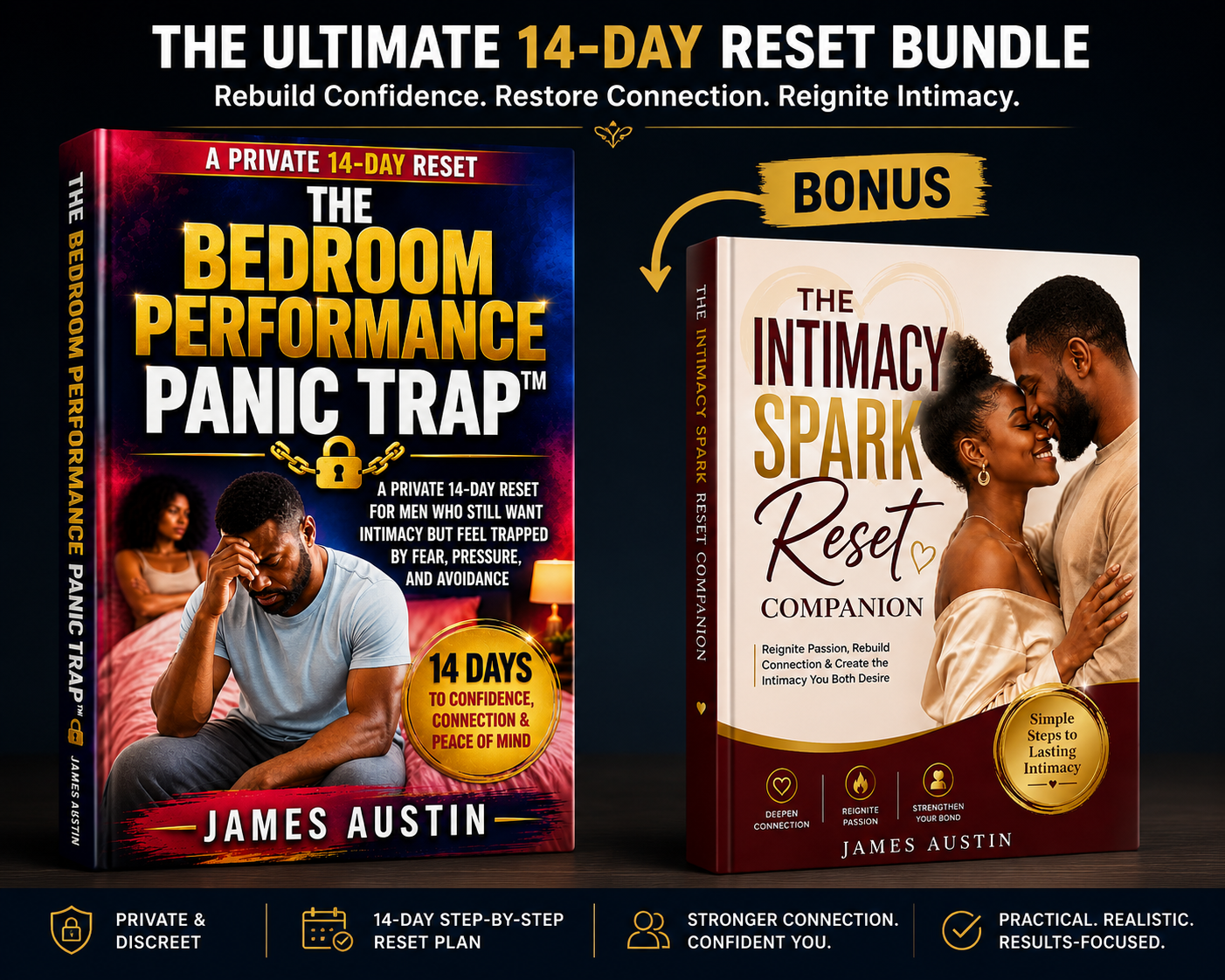
- The Bedroom Performance Panic Trap™ — Private 14-Day Reset Guide
₦15,000 - BONUS: The Intimacy Spark Reset — 30 Moments of Attention
₦5,000
Right Now, You Have Two Choices
If you close this page:
- The excuse that sounds reasonable keeps doing its work
- Avoidance solves tonight and makes tomorrow heavier
- She keeps guessing the wrong reason for your distance
- The confidence wound deepens with every avoided night
- The trap owns more of the relationship. Quietly. Slowly.
If you take action today:
- You name the cycle — and naming it changes your options
- You stop turning intimacy into an exam you can only fail
- You replace body-checking with present-moment attention
- You speak before silence creates another painful story
- You measure progress by calm, honesty, and connection — not one night
🛡 30-Day Money-Back Guarantee
Follow the Calm–Connection–Confidence 14-Day Reset™ as described in the guide. All 14 days. In order. Give the process a genuine chance. If at the end of 30 days you feel no shift in how you experience closeness, pressure and connection — contact me directly and I will return every naira. No forms. No arguments. No questions that make you feel small. This is a fair exchange. I hold up my end. You hold up yours.
One Last Thing…
Picture yourself one month from today.
Will you be going to bed without manufacturing an excuse?
Will you be telling your partner the truth before she has to guess?
Will you be noticing a checking thought — and returning to the moment instead of obeying it?
Will you be remaining kind when your body does not follow the plan, instead of punishing yourself or disappearing?
Will your partner say — the way some of the men who used this guide reported their partners saying — "You feel emotionally present again"?
Now picture yourself one month from today if you close this page.
The trap is still running. The silence is still growing. The avoidance is still doing its work — protecting shame for one more night, and making tomorrow heavier.
The difference between those two versions of you is a decision you make in the next sixty seconds.
I Choose the First Version. Let Me In.If you have read this far and you are still hesitating —
Ask yourself honestly: is it really about ₦7,500? Or is it about whether you believe you deserve to feel better?
Because ₦7,500 is less than a tank of fuel. Less than a round of drinks. Less than one Saturday evening of spending money that did not solve anything.
You have already spent far more than that — in money, in time, in emotional energy — on things that addressed the surface and left the trap untouched.
Your marriage did not build itself. Your partner did not stay through everything because it was easy. She stayed because she chose you. She is still choosing you, even now, even in the distance and the silence.
If you cannot invest ₦7,500 in understanding the trap and finding your way back to her — what are you investing in instead?
Stop hesitating. Choose yourself. Choose her. Choose what you built together.
YES — I Am Choosing. Get Me Access Now.P.S. — The 30-day money-back guarantee is real. Follow the process for 14 days. If you feel no shift after 30 days, I return every naira. No paperwork. No embarrassment. You have nothing to lose except the trap itself.
P.P.S. — This price of ₦7,500 is for the first 50 men only. When those spots are filled, the price returns to ₦15,000. There is no countdown timer on this page because I do not believe in manipulating men who are already under enough pressure. But the offer is genuine, and it will close.
P.P.P.S. — The guide ends with this sentence: "One calm step today is more useful than another month spent hiding from the Bedroom Performance Panic Trap." Every night you delay is another night the trap runs uninterrupted. Do not close this page and return to silence.
With honesty and respect for your healing,
James Austin
Frequently Asked Questions
How is the guide delivered?
Immediately after your payment is confirmed, the guide is sent directly to your WhatsApp number and your email address within 60 to 90 seconds. No waiting. No manual delivery. No follow-up required. You can begin reading within two minutes of payment.
Are the ingredients or materials easy to find in Nigeria?
The guide does not require any special ingredients, supplements or equipment. The process inside the Calm–Connection–Confidence 14-Day Reset™ is entirely behavioural and relational. Everything you need is already available to you. There is nothing to buy, order or collect from any market or pharmacy.
My situation has been going on for more than a year. Will this still work?
The guide includes specific guidance for men whose avoidance pattern has been in place for an extended period. The trap deepens over time — but the reset works in reverse order. The longer the pattern, the more important it is to follow the process in the correct sequence: calm first, connection second, confidence last. The guide addresses this directly. There is also a clear section on when the duration or nature of the problem suggests a physical cause that requires professional medical assessment.
My partner does not know about this. Do I have to tell her?
No. The guide is designed to be read and applied privately. Chapter 5 — "Break the Silence and Begin the Reset" — gives you a clear opening sentence, guidance on how to own the impact of your distance without drama, and what to do if she responds with anger. The guide also includes Appendix D with a full Partner Conversation worksheet you can complete privately before you speak. Many men begin the 14-day reset without telling their partners, and their partners notice the shift before any conversation happens. The conversation is for when it feels safe and respectful — not before.
Is the 30-day money-back guarantee real?
Yes. Follow the Calm–Connection–Confidence Reset™ for the full 14 days, in the correct order, with genuine effort. If after 30 days you feel no meaningful shift in how you experience pressure, closeness and connection — contact me directly. I will return every naira without argument, without forms, and without asking you to justify yourself. The guarantee exists because I am confident in the process. And because a man who is already struggling does not need financial risk added to everything else.
Why is this different from all the other things I have tried?
Everything else addressed the symptom. The alcohol, the supplements, the forced performances — all of them treated the problem as physical. But the guide is clear: erection difficulties can involve emotional, relationship, lifestyle, medication, hormonal, nerve, or blood-vessel factors. If the pattern keeps happening, the guide tells you to see a qualified clinician — not to keep buying products. What the guide addresses that nothing else does is the cycle: pressure load → panic trigger → body monitoring → avoidance → confidence wound → more pressure. Breaking that cycle does not require a perfect night. It requires naming the pattern, reducing the monitoring, rebuilding safe closeness, and speaking honestly. That is a different approach entirely. The guide measures success by calm, honesty, presence, and connection — not by one bodily response on one particular night.
Get Immediate Access — ₦7,500 Only
© 2025 The Real Men's Confidence Journal. All Rights Reserved.
This guide is for informational and educational purposes only. It is not a substitute for qualified medical or psychological advice. If your symptoms are sudden, persistent, painful or concerning, please consult a qualified healthcare professional.
I was not sure about this at first. I thought it would be another motivation article telling me to exercise and pray more. But this guide actually went somewhere different. The five stages of the trap — I recognised myself in stage three immediately. The monitoring. I didn't know there was a name for what I was doing. Grateful I found this.
Like (47)James writes the way a man actually thinks. Not a therapist voice. Not a salesman. Just — one man talking to another man honestly. I sent this page to my younger brother who has been struggling in his marriage. He hasn't thanked me yet but his wife WhatsApped my wife to say things are better. That is enough for me.
Like (89)The Pressure Load Audit was something I had never done before. I sat with that page for almost an hour. Just listing everything I was carrying. I didn't even realise how much it was until I saw it written down. My wife saw me doing it and asked what I was writing. I said — things I need to put down. She nodded and left me alone. She understood without needing an explanation.
Like (61)The section on when to see a doctor was what convinced me this guide was serious. Most products in this category want you to believe the solution is always inside what they are selling. This guide tells you clearly when your situation needs a qualified medical professional. That kind of honesty is rare. I trusted everything else more because of it.
Like (102)I bought this for ₦7,500. In the same week I had been considering spending ₦18,000 on another supplement my friend recommended. This guide is the reason I did not spend that money. Because it helped me understand that supplements were never addressing what was actually happening. The trap is in the mind. The reset begins there too.
Like (74)Leave a Comment